
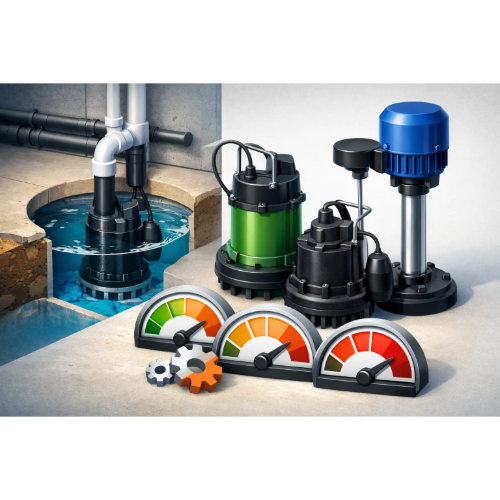
How to Select Sump Pump Horsepower
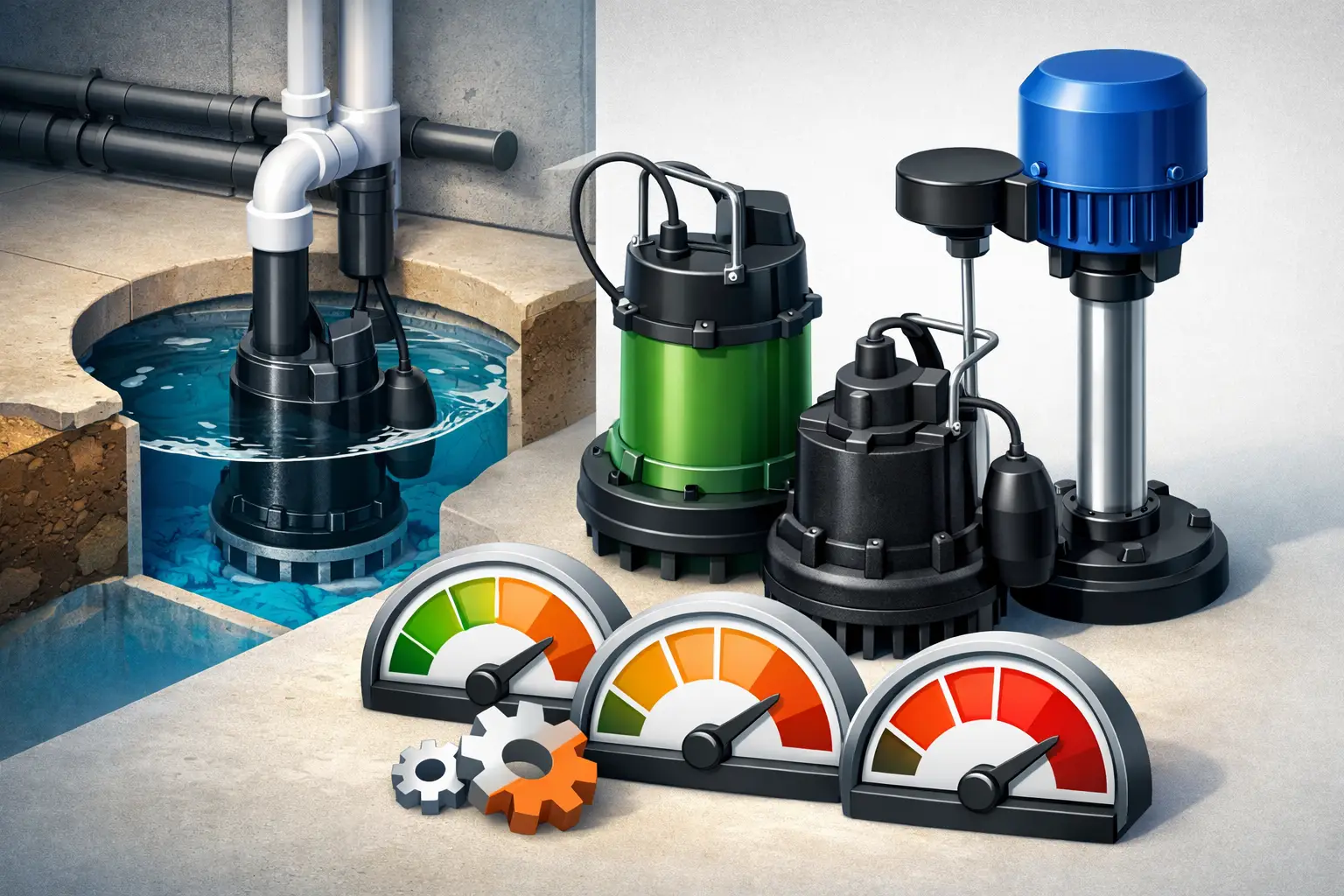
A sump pump that runs constantly and still falls behind usually does not have a motor problem first. More often, the system was sized around a guess. If you need to select sump pump horsepower correctly, you need to match the pump to the actual drainage load, discharge height, and piping conditions - not just buy the biggest motor available.
For many residential basements, the horsepower decision comes down to three common sizes: 1/3 HP, 1/2 HP, and 3/4 HP. In commercial and higher-demand drainage applications, 1 HP and above may also be appropriate. The right choice depends on how much water enters the basin, how high the pump must lift it, and how much resistance the discharge line adds along the way.
What sump pump horsepower actually tells you
Horsepower is a motor rating, not a direct measure of how much water a sump pump will move in your system. That distinction matters. Two pumps with the same horsepower can perform differently because impeller design, controller strategy, and pump curve all affect output.
The practical meaning of horsepower is this: higher horsepower usually allows a pump to maintain more flow as head pressure increases. Head pressure includes the vertical lift from the basin to the discharge point, plus friction losses from pipe length, fittings, check valves, and smaller-diameter pipe. A pump that looks strong on paper can still underperform if the real system head was underestimated.
This is why horsepower should never be selected by basement size alone. A small basement with heavy groundwater can require more pump than a larger basement with light seasonal seepage.
How to select sump pump horsepower for your application
Start with the system, not the motor label. The best approach is to estimate the total dynamic head and compare that to the expected water inflow during the heaviest conditions your property sees.
Measure vertical lift first
Vertical lift is the distance from the pump in the basin to the point where water exits the discharge line. This is the largest part of head pressure in most installations. If the discharge exits eight feet above the pump, that lift must be overcome every cycle.
In many homes, vertical lift falls in the 7 to 12 foot range. In deeper basins, crawlspace systems, or buildings with longer rises before discharge, the number can be higher. As lift increases, flow drops. That is often the reason a smaller pump starts to struggle during storms.
Account for discharge pipe losses
Pipe friction is easy to ignore and expensive to ignore. Long horizontal runs, multiple elbows, check valves, and undersized pipe all add resistance. That additional resistance reduces gallons per minute, especially when the pump is already working against a higher lift.
A short discharge run with full-size pipe allows a pump to perform closer to its published curve. A long run with several turns can make a 1/3 HP pump behave like an undersized unit even when the basin itself is not large.
Estimate peak water inflow
The next question is how quickly water enters the basin during heavy rain, spring thaw, or a high water table event. If the basin fills faster than the pump can evacuate it, horsepower is too low or the system design needs to change.
This is where real-world observation helps. If the current pump cycles every few seconds during storms, runs continuously for long periods, or cannot lower the water level enough to shut off cleanly, the system may need more capacity. If the inflow is light and infrequent, moving to a larger motor may add cost and wear without improving protection.
Review the pump curve, not just the box
The correct way to select sump pump horsepower is to compare pump performance at your estimated head. A pump may advertise an impressive gallons-per-hour number at minimal lift, but your system does not operate at minimal lift.
At 10 feet of head, one pump may still provide strong flow while another drops off sharply. That is why published performance curves and technical documentation are more useful than general marketing claims. For buyers replacing an existing unit, this is also why matching horsepower alone is not always enough.
Typical horsepower ranges and when they fit
1/3 HP sump pumps
A 1/3 HP sump pump is commonly used in standard residential basements with moderate water entry, shorter discharge runs, and lower head conditions. It can be a reasonable fit where groundwater is manageable and the pump is not expected to handle intense inflow for extended periods.
Its advantage is simplicity and economy. Its limitation is reserve capacity. If your property sees rapid water entry during storms, or if the discharge line has more lift and friction than average, 1/3 HP can become marginal.
1/2 HP sump pumps
For many homeowners, 1/2 HP is the most balanced choice. It typically offers stronger performance through common residential head ranges without stepping into unnecessarily large equipment. In homes with recurring stormwater inflow, finished basements, or a history of nuisance flooding, this size is often worth serious consideration.
It also provides more margin when discharge piping is not ideal. That extra margin matters because field conditions are rarely perfect, especially in retrofit installations.
3/4 HP and 1 HP sump pumps
These sizes are better suited to heavier-duty residential systems, deeper lift requirements, larger foundations, high groundwater conditions, and some commercial applications. They can support higher flow at greater head, but they are not automatically the correct answer for every basin.
More horsepower can mean faster drawdown, yet there are trade-offs. A pump that empties a small basin too quickly may short cycle if the basin size, switch range, or controller setup does not match the pump output. Short cycling increases wear and can reduce overall service life.
When bigger is not better
Oversizing is a real issue in sump systems. Many buyers assume a larger motor always means better flood protection. Sometimes it does. Sometimes it creates a different reliability problem.
If the basin is small and inflow is relatively modest, a high-horsepower pump can cycle on and off too frequently. Repeated short runs generate heat, stress electrical components, and wear switches and controllers faster. The result is a system with more theoretical capacity but less stable operation.
There is also the battery backup question. If you use a backup system, a larger primary pump may not change backup runtime, but system expectations often do. During outages, buyers sometimes assume the backup will match a large AC primary pump. That depends on the battery system design, controller, and pump type. Primary pump horsepower and backup planning should be considered together.
Replacement decisions: match or re-size?
When replacing a failed sump pump, many people simply read the existing motor label and order the same horsepower. That works only if the original system was correctly sized and the site conditions have not changed.
If the old pump ran for years without flooding, excessive cycling, or performance complaints, matching the existing horsepower may be appropriate. But if the system always seemed to struggle, replacing it with the same size may repeat the same mistake.
Look at the full setup: basin diameter and depth, float or controller range, discharge pipe size, check valve condition, and total head. If water conditions have worsened over time, a re-size may be justified. If the pump failed because of switch wear caused by rapid cycling, the answer may be control strategy or basin configuration rather than horsepower alone.
Select sump pump horsepower with backup protection in mind
A primary sump pump should not be sized in isolation. In real flood events, the reliability of the entire system matters more than the motor rating on the main unit.
If your property has a finished basement, valuable equipment below grade, or repeated power outage exposure during storms, backup protection should be part of the sizing conversation. That includes battery backup systems, alarm capability, and controller-based monitoring where appropriate. A well-sized 1/2 HP primary with dependable backup is often a better protection strategy than a larger standalone pump with no contingency plan.
For contractors and facility operators, this is especially important in applications where downtime is unacceptable. A correctly sized primary pump handles normal demand, while the backup strategy addresses failure events and outage conditions.
Common sizing mistakes to avoid
The most common mistake is choosing based on horsepower only. The second is choosing based on price only. The third is ignoring discharge conditions and focusing only on basin inflow.
Another frequent issue is assuming all 1/2 HP or all 3/4 HP pumps are interchangeable. They are not. Build quality, controller design, switch type, impeller performance, and pump curve shape all affect real operation. In a specialized category like sump equipment, that is why detailed specifications matter.
If you are buying for a property with known water issues, the safest path is to size from actual conditions and documented performance data. SumpDirect focuses on that kind of equipment selection because matching horsepower to the application is only one part of building a dependable drainage system.
The right pump should handle your worst realistic water event without running at its limit every time it rains. That is usually the clearest sign you selected the horsepower based on the job instead of the label.